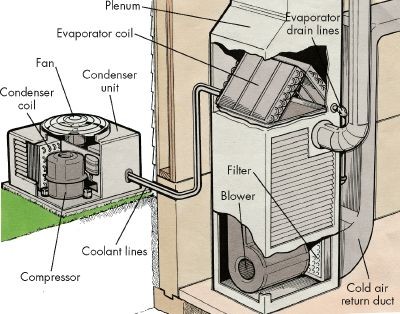
Central air conditioning isn’t one single unit. It’s two distinct parts working in tandem. You have the condenser, which sits outside on a concrete pad. Then you have the evaporator coil, tucked inside above your furnace in the plenum or main duct junction.
Most homes connect these components to the forced-air system. That means the blower motor, the ductwork, and the furnace fan handle the heavy lifting for both heating and cooling. You aren’t running a separate loop for cold air. The same ducts that push warm air out in winter are pushing cool air out in summer.
When the system is running, here is the cycle:
- Hot indoor air gets pulled back through return-air ducts toward the furnace.
- The blower pushes this air across the cooled evaporator coil.
- The air drops in temperature and is forced through the supply ducts into your rooms.
If the AC is running but your house stays hot, don’t blame the compressor outside. The issue likely lies in the distribution system. Is a duct leaking? Is the blower failing to move air? Is a filter completely clogged? The problem is almost always inside the walls or above the ceiling, not on the concrete slab outside.
When the air conditioner works but the house doesn’t cool, the problem is probably in the distribution system.
Check your filters first. Clear blockages. Ensure vents aren’t blocked by furniture. Sometimes the fix is as simple as clearing a path for the air to actually reach the rooms you’re trying to cool.
Why Your Central AC Needs More Than Just a Technician
Your central air system is a two-part machine. Outside, on that concrete slab, sits the condenser unit. Inside, tucked above your furnace, is the evaporator coil. Both are sealed systems. That means you shouldn’t be poking around the refrigerant lines or opening the compressor housing. If it leaks or fails internally, call a pro.
But sealed doesn’t mean untouchable.
You need a professional inspection before the cooling season starts. They check pressures. They check electrical connections. They tighten what’s loose. That’s step one.
Step two is maintenance you actually do yourself.
Most homeowners think their only job is to call the repairman when the heat wins. That’s a mistake. Dirty coils kill efficiency. Clogged drains cause leaks. Debris chokes airflow. You can fix these. You just have to know where to look.
Warning: Turn off the power. Both at the breaker for the condenser and the switch near the furnace. Electricity and water don’t mix. Don’t be stupid.
If your AC is acting up, don’t guess. Look at the symptoms. Here is a quick map of what’s likely wrong and whether you can fix it with your own hands.
Troubleshooting: The DIY Checklist
Before you strip the system down, narrow the scope. Is it the power? Is it dirty? Is it broken?
| Symptom | Likely Cause | DIY Fix? |
|---|---|---|
| Condenser won’t start | Tripped breaker or blown fuse | Yes. Check the panel. Restore power. |
| Thermostat set too high | Yes. Lower it by 5 degrees. | |
| Motor or compressor dead | No. Call a pro. | |
| Uneven cooling | Ductwork imbalance | Maybe. Requires balancing dampers. |
| Inadequate cooling | Thermostat set too high | Yes. Lower setting. |
| Evaporator coil dirty | Yes. Clean it (see below). | |
| Unit is too small for the house | No. You need a larger unit. | |
| Compressor failure | No. Call a pro. | |
| Low refrigerant | No. Sealed system leak. Call a pro. | |
| Unit cycles on/off rapidly | Dirty condenser coils | Yes. Clean them. |
| Debris blocking airflow | Yes. Clear weeds, grass, vines. | |
| Dirty evaporator coil | Yes. Clean it. |
If you are seeing “inadequate cooling” or “rapid cycling,” the odds are high that your coils are dirty. That brings us to the dirty work.
How to Clean the Evaporator Coil
The evaporator lives in the plenum, right above your furnace. It’s not always easy to see. In fact, in many homes, it’s hidden behind foil-wrapped insulation or inside a sealed metal box.
If your plenum is a sealed sheet metal box, stop. Do not open it. You’ll void warranties and likely break something.
But if there’s foil insulation taped to the front, you have access. Here is how to clean it without making a mess or breaking a pipe.
Step 1: Gain Access
Peel back the foil insulation. It’s usually held by tape. Be gentle. You need to put it back. Peel the tape off carefully. Behind the foil is an access plate, held on by screws. Remove the screws. Lift the plate off. You should now see the underside of the coil.
Step 2: Brush the Coils
Grab a stiff brush. A large hand mirror helps you see the back rows if your arm isn’t long enough. Brush the fins. Remove the dust bunnies and grime. If you can’t reach the back, you can slide the coil out slightly. It might have rigid pipes attached. Slide it carefully. Do not bend the pipes. Bent pipes mean refrigerant leaks. That means a pro.
Step 3: Clear the Drain
Look below the coil. There is a pan that catches condensation. It has a weep hole. Pour one tablespoon of household bleach into that hole. This kills the fungus and algae that clog drains.
In humid weather, check this pan every other day. If water stays in the pan, the weep hole is clogged. Use a piece of wire to clear it. A clogged drain can overflow and damage your ceiling.
Step 4: Reassemble
Slide the coil back in. Replace the access plate. Screw it tight. Tape the insulation back over it. Seal any gaps with duct tape. Air leaks here mean your AC is cooling your ductwork, not your house.
Step 5: Test
Turn the power back on. Turn the AC on. Feel the air coming out. Is it cold? Does it smell okay? If you hear rattling or see leaks, shut it off and call a pro.
Cleaning the Outdoor Condenser Unit
The evaporator is just half the battle. The condenser outside takes the heat from inside and dumps it outside. If it can’t dump the heat, it can’t cool your house.
The condenser coil gets coated in dust, pollen, and lawn clippings. This acts like a blanket. It insulates the heat instead of releasing it. The result? Your unit works harder. Your电费 goes up. The compressor burns out.
You need to clean the condenser coil.
Clear the area around the unit. You need at least two feet of clearance on all sides. Cut back any vines, weeds, or tall grass. They trap moisture and debris. They also hide snakes. Check before you reach in.
Use a garden hose to spray the coil. Start from the inside and push the dirt out. Do not use a pressure washer. It will bend the fins. Bent fins reduce airflow. If the fins are bent, you can straighten them with a fin comb. You can buy these at any hardware store for a few dollars. It’s worth it.
Check the fan motor. Does it spin freely? Is it noisy? If the fan is struggling, the unit will overheat. That’s a job for a technician.
But for most people, a good rinse and some brushwork is enough to bring the system back to life.
Don’t wait for the first heatwave to check your AC. It’s easy to forget until the sweat starts. Do it now. Check the breaker. Clean the coils. Clear the drain. It takes an afternoon. It saves thousands in repairs.
Your home is a system. Treat it like one.
Clearing the Outdoor Coil
Most of the grime finds its way onto the condenser because it lives outside. Leaves. Lawn clippings. Dust. It all piles up and chokes the fan. The fan pulls air across the coil to dissipate heat. If that intake is blocked, the whole system struggles. You need to know which way the air flows before you start scrubbing. Most units pull air in from the sides and blow it out the top. But check yours. It could be different.
First, cut back the vegetation. Grass, weeds, vines—they all obstruct airflow. Give the unit a wide berth. Next, you need to clean the coils. Grab a commercial coil cleaner from a appliance supply store. Follow the bottle instructions. Spray it on. Let it sit. Then flush it off with water. Do not use a high-pressure hose. That forces dirt into the fins where it becomes a cement-like paste. Let it air dry completely.
The fins themselves are fragile. Light-gauge aluminum. Bend one and it’s done. Use a soft brush to lift the dirt. You might have to take off the protective grille to reach them. If a fin is bent, don’t just poke at it with a knife. Get a fin comb. It’s a cheap tool sold at appliance parts stores. It slides between the fins and straightens them in one pass. Be gentle. One wrong move and you reduce the surface area for heat exchange.
Check the base. The condenser sits on a concrete pad. Over time, that pad settles. If the unit isn’t level, the compressor oil pools in the wrong place. That kills the compressor eventually. Use a carpenter’s level on top of the unit. Front to back. Side to side. If it’s low on one corner, lift it with a pry bar or a sturdy 2×4. Wedge gravel or rocks underneath to level it out.
When winter comes, cover the unit. Leaves will clog the coils if you leave it open. Ice can damage the fins. Use a commercial cover that matches the shape of your unit. Or use heavy plastic sheeting. Secure it tightly with sturdy cord so wind doesn’t whip it around. Don’t tape it shut. The unit needs to breathe even when idle.
If you’ve cleaned everything and it’s still blowing warm air, you might be looking at a refrigerant issue.
Handling Refrigerant Lines
Freon is the coolant. If the system isn’t holding the right amount, you get no cooling. Period. If you smell sweet or chemical odors, or if the lines are sweating heavily, you might have a leak. Do not try to recharge the system yourself. Refrigerant handling requires certification and special equipment. Messing with pressurized lines is dangerous and illegal if you aren’t licensed. Call a professional.
However, you can handle the insulation. Follow the copper lines from the outdoor condenser into the house where they meet the evaporator coil. Look at the insulation wrapping. Is it torn? Cracked? Missing? Damaged insulation lets cold lines absorb heat from the surrounding air. It reduces efficiency. It can also cause condensation to drip on your floor or walls.
Replace the worn insulation immediately. Buy new foam pipe insulation of the same diameter and type. Cut it to length. Slide it over the line. Seal the seams with mastic or specialized tape. Make sure there are no gaps. Cold lines must stay cold until they reach the evaporator.
You now know what you can fix and what needs a pro. You can save money on the cleaning and insulation work. Get the air flowing again.
For more on keeping your home running, look into repairing window units. They share principles with central air but have different internals. Check the big appliances too if the A/C isn’t the only thing failing. And don’t forget the thermostat. Calibrate it. Sometimes the problem isn’t the machine, it’s the signal.