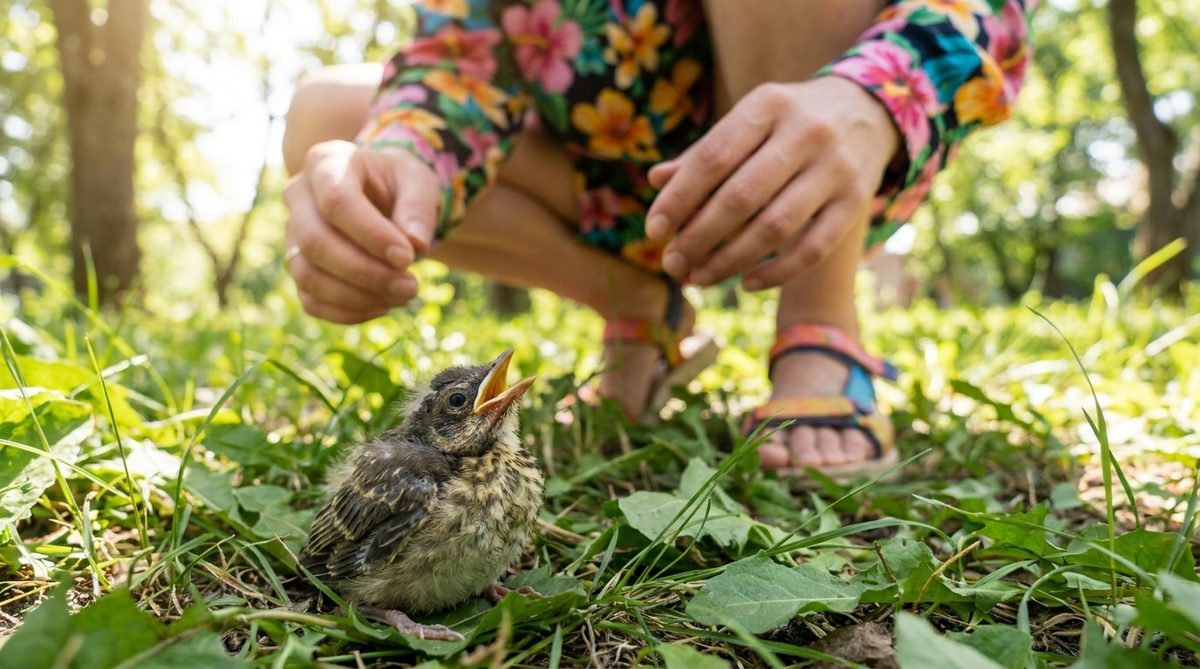
Summer hits hard. Your garden is exploding with green. Birdhouses buzz with activity. You spot a tiny, ragged ball of feathers hopping awkwardly at the base of an oak tree. It looks lost. It looks vulnerable. Your human instinct screams to scoop it up.
Don’t do it.
That surge of affection? It’s often the first step toward tragedy. We think we are saving a life. Often, we are just disrupting a carefully choreographed survival strategy. Let’s look at the biology behind the behavior. Stop treating every chirping chick like a distress signal.
The Vet’s Office and the Myth of the Hero
Picture the scene. You rush the bird into a cardboard box. You drive frantically to the emergency vet. You feel like a hero. The vet looks at the bird. Then they look at you. The diagnosis is blunt.
Most wild birds found on the ground are not orphans. They are fledglings. They are learning to fly. By removing them from their environment, you haven’t saved them. You’ve condemned them to captivity or death. Veterinarians see this mistake daily during summer nesting seasons. Our mammalian urge to protect clashes violently with avian biology. It’s an emotional whiplash. One minute you’re compassionate. The next, you’re guilty.
The Ground Is a Classroom, Not a Grave
Here is the secret the birds aren’t shouting. The “lost” bird is usually just practicing. They jump from the nest intentionally. Parents encourage this. They push them toward independence. For days, these young birds hop around. They stretch wings. They map the territory.
Your lawn isn’t a danger zone. It’s a playground. It’s a training ground. The cycle of nature relies on this ground time. It builds muscle. It builds resilience. When you pick up a healthy fledgling, you are interrupting its education.
Invisible Parents
The bird looks alone because its parents are hiding. This is a survival tactic. If parents hovered openly over a chick on the ground, predators would strike. So they go ghost.
They perch high in the canopy. They watch. They dive in for quick feedings of insects or caterpillars. They leave immediately. If you approach, you break that rhythm. You become a threat. The parents will wait for you to leave before returning to feed the chick. Your interference starves the bird. It stresses the parents. It stops the food supply.
The Difference Between Rescue and Abduction
Understanding this distinction is vital for any gardener or homeowner. Picking up a fledgling that is capable of hopping and fluttering is essentially an abduction. The bird loses its connection to its territory. It loses the lessons its parents were teaching it about local food sources and local calls.
Worse still, trying to feed it yourself is catastrophic. Bread? Insect traps? Wrong. Improper nutrition causes fatal deficiencies. Plumage deformities set in within days. Wild birds require specific diets that only their parents can provide correctly.
When You Actually Need to Intervene
There is one exception. A clear line in the sand.
If the bird is barely feathered. If its eyes are still closed. If it looks like a naked, squirming mess. This bird fell too early. It is in absolute distress.
In this case, act fast. Look up. Find the nest. It’s usually directly above where you found the bird. Place the chick back inside. Gently.
Ignore the old wives’ tale about scent. Birds have a poor sense of smell. The parents will not reject a chick because you touched it. They just want their baby safe.
If the nest is destroyed. If it’s too high to reach. If you cannot locate it. Then, and only then, contact a licensed wildlife rehabilitation center. Do not keep it as a pet. Do not try to raise it yourself. You are not equipped for that level of care.
Keep your hands in your pockets. Let the birds figure out the rest. The garden is safer when you stop trying to fix what isn’t broken.
But what about the ones that actually need help? The ones with injured wings? The ones trapped in fences? That’s a different conversation. And a harder one.
Protecting the Landing Zone Without Breaking the Bird Family
When you see a fledgling hopping around with its feathers fully formed, resist the urge to scoop it up. Your goal isn’t capture. It’s securing the perimeter. You need to create a safe zone for this young bird to learn. Here is how you handle it without causing stress or breaking the natural cycle.
First, clear the predators. If you have cats or dogs, keep them indoors. Not for days. Just for a few hours while the parents are likely making their rounds. Give the little one a chance to practice flying without being stalked by a curious pet.
If the bird is down in a busy spot, move it only if necessary. If it is on a road or in a high-traffic area, gently place it higher up. A shady branch or a small retaining wall works. Just get it out of the line of fire. But do not move it far. Keep it within eyesight of where it fell.
Then, step back. Observe from a distance. Hide behind a window. Watch. Are the parents coming back? Do you see them flitting in and out? If yes, they are feeding it. They are teaching it. You are not needed.
Hold off on the yard work. If you planned to mow the lawn or trim the nearby hedge, wait. Give the area a break. Let the grass grow a bit long. Let the bushes stay thick. It creates cover. It creates safety.
This is not about ignoring wildlife. It is about understanding it. A clumsy bird is not an abandoned bird. It is a bird in training. Falling is part of the process. When you accept this, you stop becoming an amateur rescuer and start becoming a true guardian of biodiversity.
You will only act when the situation truly demands it. Not every time you see something awkward. This shift in perspective changes how you view your own backyard. You start looking at your green spaces differently. You see them as stages for life, not just lawns to maintain. You learn to respect the seasons. And the learning continues.