


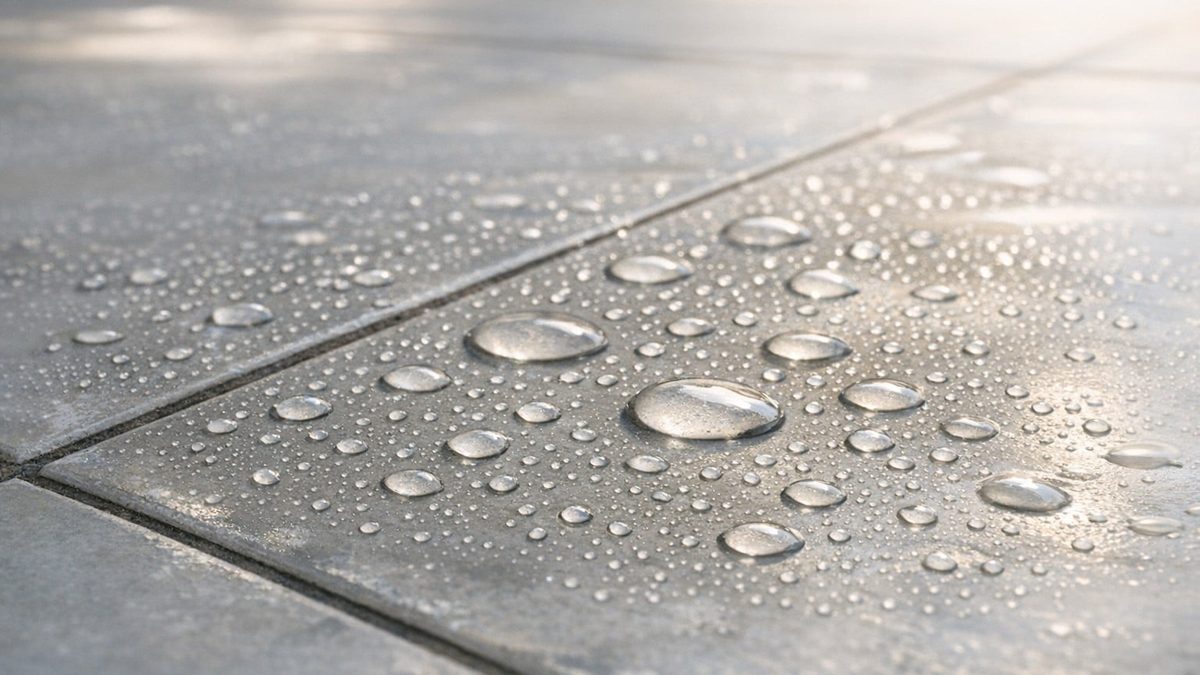
Every summer, the script is shown in thousands of homes. You go into the bathroom or kitchen and notice that the tiles are wet. No faucet drips. No pipe is burst. The instinct is to pick up the phone and call the plumber. But most of the time, the plumber leaves empty-handed after charging you a service fee for nothing.
The real culprit is not the leak. It’s condensation.
This is a common physical phenomenon that is rarely clearly explained to homeowners. It creates the illusion of a major plumbing disaster when the problems are simply physical. By understanding how to identify condensation on tile floors you will save money, time and unnecessary stress.
Physics of wet tiles in summer
Heat and humidity are natural partners. The warmer the air, the more water vapor it can hold. If your tile is installed on top of a concrete slab that is directly on the ground, the tile acts as a thermal bridge.
The slab never heats up at the same rate as the outside air. It stays cool.
Condensation occurs when warm, moist air hits a surface that is cold enough to reach the dew point. The dew point is the temperature at which the air can no longer hold all its water vapor and therefore liquefies. Your cold tile acts like a chilled glass of soda on a hot patio. Water beads on the outside of the glass. The same thing happens on your floor.
This effect peaks just before a summer storm. The air becomes saturated with moisture. The ground stays cool. When these two factors collide, condensation quickly forms. It looks like a flood. It’s just water vapor that turns back into a liquid.
Condensation on your floor is not a leak. Air releases its moisture when it hits a cold surface.
Simple test: condensation vs. Water Leak
You can tell the difference in three minutes. You need a clear plastic bag and tape.
- Wait until your floor is wet.
- Attach a small piece of plastic directly to the tile. Seal the edges well to no air can get underneath.
- Wait a few hours.
Check the plastic.
- If moisture forms top side (facing the room air), it is condensation. Water came from the air.
- If moisture forms on the bottom side (under the plastic), the water rises through the floor. This indicates capillary action or a persistent moisture source of moisture from below.
There are other clues. Condensation usually evenly covers the entire surface of the tile. This happens most often in hot, humid weather. In contrast, the leak is usually localized. It accumulates around a particular pipe, connection or baseboard. Leaks often cause a musty smell or cause the grout to darken over time. Due to capillary rise, the grout lines are wetter than the tile itself. Condensation moistens everything evenly.
Why some Homes are more Prone
Indoor air humidity is typically 40-60%. Anything higher involves risk. Ground floor apartments, basements and poorly ventilated rooms are at greatest risk. In these rooms, the tile stays cold longer. Stagnant air causes moisture to accumulate without escaping.
Temperature differences are also important. If the room temperature is 20°C (68°F) and the Dew Point is 5°C (41°F), condensation is unlikely. The difference is too great. However, if the room temperature is 20 °C and the Dew Point is 18 °C (64 °F), condensation will occur immediately. The air is almost full of water and the ground is cold enough to trigger it.
Older buildings is often worse. Many were built without insulation under a concrete slab. Without this thermal barrier, the ground chill goes directly into the living spaces. Even with a good ventilation system, a cold wall or floor absorbs moisture from the air. The water has to go somewhere. It lands on your floor.
Breaking the Cycle
No major renovations are needed to pause this. The purpose is to manage the air and surface temperature.
Ventilation is the first line of defense. Open the windows during the cooler parts of the day. Use exhaust fans in bathrooms and kitchens to push moist air. In severe cases, especially in basements, dehumidifiers can help. They pull water out of the air before it hits the cold tile.
Improving air circulation under furniture also helps. Stagnant pockets of air retain more moisture. If possible, keep rugs and heavy furniture away from cold tiles or allow air to circulate around them.
For a long-term fix, consider thermal insulation. Adding a vapor barrier or insulating layer under the floor prevents the cold from reaching the surface. This changes the surface temperature to stay top side the dew point. It’s more work, but it solves the root cause.
The next time you see wet tiles in July, pause. Do not panic. Check the weather. Check the air. Test with plastic. You might just find that the water is coming from above and not the bottom side.
无需大修即可修复表面凝结
好消息是,大多数表面凝结不需要撕毁地板。 您无需大量施工即可阻止它。 秘密是什么? 空气流动。 停滞的潮湿空气需要移动。 让它移动,瓷砖温度就会升高到露点以上。
在热浪期间这感觉不对。 在 38°C 的闷热下午和暴风雨般的湿度下打开窗户会使情况变得更糟。 你将湿热的空气引入室内。 这就是陷阱。
正确的开窗策略是违反直觉的。 一大早就做。 或者等到晚上。 瞄准室外空气冷却的时间。 新鲜、凉爽的空气取代了饱和的室内空气。
Mechanical ventilation and dehumidifier
In chronic problems, rely on a ventilator. Controlled Mechanical Ventilation (VMC) systems are preferred. Actively extract moist air from inside your home. Don’t forget the mechanics. Adding a separate dehumidifier can be helpful.
The heat will slightly reduce condensation. However, it alone does not solve the water leakage problem. It won’t stop rising damp. If moisture appears regularly, heat is just a bandage.
If the humidity is high, like in summer, bring a dehumidifier. Outdoor air typically contains more water vapor than indoor air. By removing moisture from the mixture, it prevents water from accumulating on the surface.
If you notice recurring mold or condensation on your walls, a portable unit is not enough. Centralized VMC system required. This is the only way to permanently improve air quality in the long term.
Insulation as a Thermal Barrier
One form of treatment that is often overlooked is insulation. Improved insulation brings the wall temperature closer to room temperature. The thermal gap between the cold slab and the warm air decreases. The smaller the gap, the less condensation occurs.
In small cases, placing a thin insulation underlay under the tile can make a difference. There is no need to remove the floor. Just add layers. Solve physical problems, not pipes.
The problem isn’t your plumbing. This is the behavior of air and temperature.
“The problem is not the pipes. The problem is the physics of the air.”
Source: carrelage.ooreka.fr | elements-carrelage.com


