


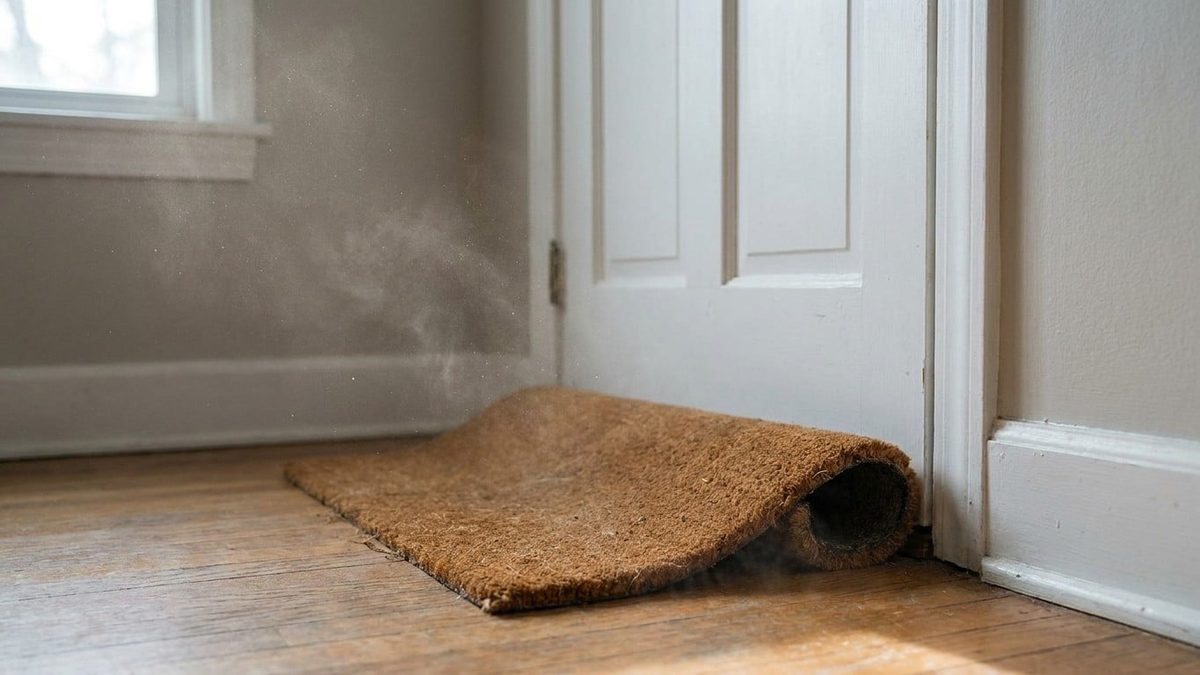
It rattled violently every time the wind picked up. All summer long. Then one day it stopped.
The problem is not the door itself. The hinge is fine. The real reason is a simple Doormat in front of the door. Completely block the flow of air under the second door of the home.
This is a classic case of invisible obstacles turning your home into a pressure chamber. We often blame drafts or bad hardware, but physics tells a different story. The door closes like a trap with a small pressure difference. And the repair probably costs zero euros and takes less than a minute.
How to find the culprit of hidden drafts
There is no need to contact the contractor to find out the source of the slamming. Just lift the doormat from the front door. Next, open the front door fully and hold it against a wall or nearby furniture.
Now listen.
If the kitchen door (or any other interior door) stops slamming, you know there’s a problem. There is a barrier under the entryway door that prevents free air circulation.
This test takes 30 seconds. Save time adjusting hinges or buying unnecessary dampers.
It’s not just about the wind, it’s about the pressure
Contrary to popular belief, this is not a simple “draft” or “draft”. This is a pressure imbalance between two areas of your home.
A draft is the result of pressure gradients. As this gradient passes through the open door, the air tries to balance itself. Depending on the direction of this air flow, the door can open further or slam shut.
This phenomenon is surprisingly sensitive. On a physics forum, one user pointed out that a pressure difference of just 1 bar across a door creates a force equivalent to 20 tons. Even on a microscopic scale, the forces involved are enormous. Even small pressure differences can cause the door to slam shut.
Why is there a gap at the bottom of the door?
Make sure the entryway door does not touch the floor. This is intentional.
Construction professionals call this “bottom clearance” or “detaronage.” This is the space under the door that takes into account the air flow between the rooms. This airflow replaces the visible ventilation grill more discreetly.
In a standard door (width approx. 1 meter), this gap forms an air passage of approx. 200 cm². It is approximately the size of A4 paper. This particular area regulates the pressure between the rooms, preventing pressure from building up on one side and pushing the other side open or closed.
Door mat: an invisible barrier
If the door mat is too thick, incorrectly placed, or slightly loose, it can block this important air channel under the front door.
Air that would otherwise flow between the exterior and interior is trapped in that location. The pressure was still searching for balance, but it found another way. It pushes or pull another door, such as a kitchen door, with surprising force.
Building regulations are strict in this regard. Corridors should be dimensioned in such a way that the pressure difference between closed doors remains below 5 Pascals. This low threshold shows how easily small obstacles can disrupt the entire system.
Other reasons to check
Doormats are not always to blame. Before jumping to conclusions, it’s worth considering other common factors.
If the hinges are worn or misaligned, they may close unexpectedly. If the door is unbalanced or hanging off the door frame, it can cause the door to close too quickly. If the screws are loose, the door may sag and not close smoothly.
Unbalanced mechanical ventilation systems are also important. When the kitchen hood or bathroom vent removes air faster than fresh air can enter, your home becomes depressurized. Fresh outside air is brought in through the gaps in the doors and windows to balance the pressure.
Things to check at home
Before you invest in a door closer or take off the hinges, start with the basics. Walk around the house and check all the doors.
Make sure nothing blocks the space under the door. Look for thick carpets, high thresholds or wedges that are out of place. These small and often overlooked items can interfere with the airflow your home was designed for during construction.
In some cases, moving the carpet a few inches will restores silence. This is a zero-cost solution that you should try before reaching for the toolbox.
Source: fr.quora.com | ffbatiment.fr


