


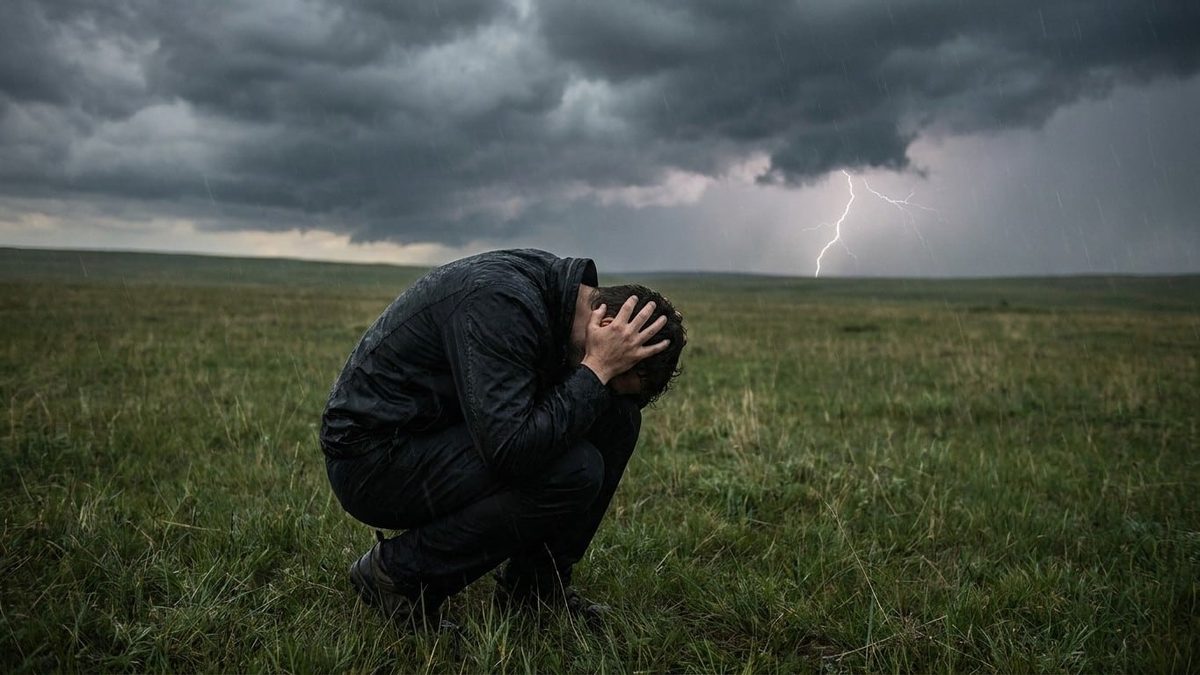
Every year in France, lightning kills about a dozen people. The number seems low. It isn’t. Thirty-five percent of these victims share one terrifying commonality. They were standing under a tree when the sky opened up.
Not in an open field. Not on a mountain peak. Under a tree.
That instinct to seek shelter under the branches is wrong. It is lethal.
The human brain tells you to run for cover. Nature draws the eye to the highest point. But in a thunderstorm, that high point becomes a target.
The Tree Is a Target, Not an Shelter
Here is the hard truth: an isolated tree is fifty times more likely to be struck by lightning than a standing human.
Fifty times.
When lightning hits a tree, it doesn’t stop at the trunk. The electrical charge travels down the bark and into the roots. From there, it radiates outward through the soil like ripples in a pond. Anyone standing within several meters of that tree becomes part of the circuit. The ground around you becomes electrified.
This phenomenon is called step potential, or “tension de pas.” It sounds technical. It is simple physics. If your feet are apart, one foot is at a different electrical potential than the other. The current seeks the path of least resistance. Your body becomes that path. The electricity jumps from your high-potential foot, through your torso and legs, to your lower-potential foot.
You need to move at least three meters away from the trunk. Three meters. Less than the width of a double bed. Most people don’t move that far. They hunch against the bark, soaked and praying. Don’t do that.
Instinct vs. Physics: Why Your Reflexes Kill You
We are wired to react. When the thunder rolls, we run. We spread our legs for balance. We lie down to hide.
All of these are bad ideas.
Running increases stride length. Long strides increase step potential. You are actively maximizing the voltage difference across your body.
Lying down is worse. It increases your surface area contact with the ground. If lightning strikes nearby, more current flows through you. More path for death.
Consider Jean-Luc Mellé. In 2017, he sought refuge under a tree during a storm. He wasn’t alone. Lightning struck near him. Twenty other people were hit simultaneously by the current spreading through the soil. He survived, but with lasting injuries. The event proves how quickly instinct turns fatal.
The data backs this up. In France alone, lightning strikes 100 to 300 people annually. In Europe, experts at Météorage recorded 215 strikes in a decade. Eighty-three deaths. Nearly one thousand injuries. Most of these accidents were preventable. They required only basic knowledge of physics.
The Position That Saves Lives
Experts agree on the protocol. It is counterintuitive, but it works.
Get into a lightning crouch.
- Squat down. Keep your feet together. Touching toes.
- Minimize contact. Crouch on an insulating material. A backpack, a dry jacket, a rope. Do not sit directly on the wet ground.
- Protect your head. Tuck your head between your knees. Cover your ears with your hands.
Why feet together? When your feet are touching, there is no difference in electrical potential between them. Zero step potential. No current flows through your legs. You break the circuit.
The insulation under your feet adds a layer of safety. It raises your resistance against the ground. If the strike is close, the current may arc, but the insulator helps block the flow into your body.
Covering your ears protects your eardrums from the blast wave of the lightning discharge. It sounds minor. It isn’t. The pressure wave can cause permanent damage.
Group Safety Matters
If you are with others, do not huddle together.
Spread out. Maintain a distance of at least three meters between each person.
Lightning can jump. If one person is struck, the charge can arc to someone standing too close. This is side flash. One victim can electrocute their neighbor. Solidarity here costs lives. Stay apart.
The Reality of Risk
France sees significant lightning activity. The volume is high. The risk is real.
Knowledge is your best defense. Instinct is your worst enemy.
When the sky darkens, do not look for the nearest tree. Look for a solid building. If that isn’t available, look for a dense stand of uniformly short trees. Never an isolated giant.
If you are caught in the open, remember the crouch. Feet together. Head down. Isolate from the ground.
It isn’t pretty. It isn’t comfortable. But it keeps your heart beating.
The next time thunder rolls, your brain will scream to run under the nearest oak. Ignore it. Your life depends on doing the opposite.
Why You Should Stop Hiding Under Trees
The myth of the tree as a safe haven persists, despite repeated warnings. Data shows that in one out of four lightning-related accidents in France, victims were sheltering under trees or in flimsy structures like wooden sheds. This isn’t just a statistical anomaly. It is a dangerous habit that costs lives every summer.
The risk period runs from May through September. Storms peak in the afternoon heat. Yet many people assume safety once the rain stops. That logic is flawed. Lightning can strike up to ten kilometers away from the storm’s center. You might be walking in clear skies when a bolt hits. This phenomenon is known as a “bolt from the blue.” Waiting for the first raindrop to seek cover is already too late.
The Science Behind the Strike
Lightning is not just loud. It is violently hot. A single channel reaches 30,000 degrees Celsius. That is six times hotter than the surface of the sun. When it hits a tree, the sap inside boils instantly. The resulting steam expands faster than the wood can contain it. The tree explodes. Bark flies off at the speed of sound.
The ground itself becomes a hazard. Current spreads out from the impact point. If your feet are apart, voltage difference between them can send current up one leg and out the other. This is called step potential. It can stop your heart or cause severe burns.
How to Position Your Body
If you are caught outside with no substantial building nearby, your posture matters. Drop to a crouch. Keep your feet close together. This minimizes the surface area exposed to ground current. Do not lie flat. Lying down increases your contact with the conductive soil and widens the voltage difference across your body.
Crouch on the balls of your feet. Tuck your head. Reduce your profile. You are not eliminating risk. You are reducing the likelihood of a fatal circuit forming through your body.
The Thirty-Minute Rule
How long do you wait after a storm passes? The standard advice is thirty minutes after the last clap of thunder. Lightning can strike well after the rain has stopped. The storm’s energy can travel far ahead of the visible clouds.
Météorage, a subsidiary of Météo-France, tracks these strikes using a network of sensors. Their data confirms that over 95% of strikes occur between May and September. This window overlaps with peak outdoor activity. Hiking. Gardening. Village festivals. Amateur football matches on open fields. The danger is highest when people are most relaxed.
What About Shelters?
Wooden cabins or metal sheds offer little protection if they are not fully enclosed and bonded to ground. A simple lean-to does nothing. A car with a metal roof is safer, but only if windows are closed and you do not touch the metal frame. The current travels around the exterior, a principle known as the Faraday cage effect.
But for most people, the best shelter is a substantial building with plumbing and electrical wiring. These systems help ground the charge. If you are near a structure, get inside. Close the windows. Stay away from cords and plumbing.
Staying Safe in Open Areas
If you are in an open field or ridge, avoid the highest point. Lightning seeks the tallest object. But do not huddle with a group. Spread out. If one person is struck, others should not be close enough to suffer from ground current or side flash.
Keep your distance from isolated trees. The “cone of protection” around a tree is a myth. The current spreads in all directions. A safe


