Cascading delays are a critical, yet often underestimated, threat to construction projects. These delays occur when one missed commitment triggers a chain reaction, amplifying setbacks and potentially derailing entire schedules. Projects can easily experience 10% or more duration increases due to this ripple effect. This article explores the nature of cascading delays, why they happen, and how the LBMS controlling system can proactively prevent them.
The Anatomy of a Cascade
Cascading delays happen when a failure by one party directly impacts the next in a sequence. The initial setback isn’t isolated; it becomes a domino effect, with each subsequent step suffering further delays. Without intervention, this can quickly spiral into chaos, jeopardizing project timelines and quality.
Research, including a PhD thesis conducted between 2005-2009, demonstrated this phenomenon across three Finnish projects. The analysis of subcontractor and owner meeting minutes, alongside schedule control data, revealed how a single flawed decision or unmet commitment consistently led to 10% delays in overall project completion. While these projects ultimately met deadlines through compressed commissioning phases, the underlying instability foreshadowed long-term punchlist issues.
Visualizing the Chain Reaction with Flowline Diagrams
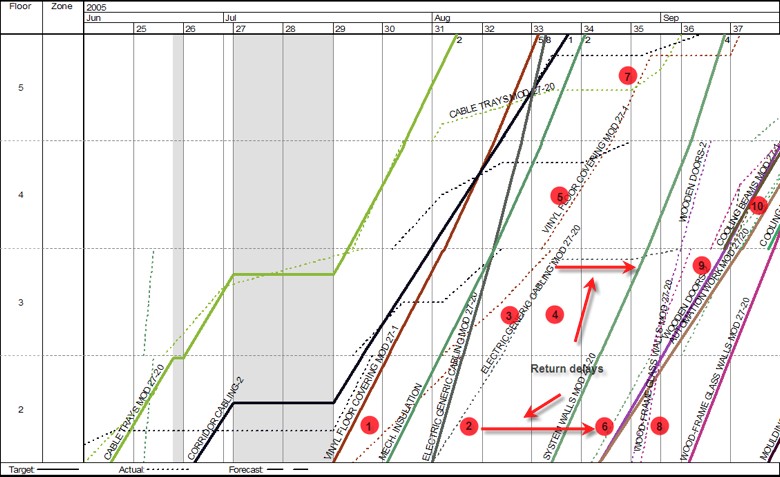
Flowline diagrams provide a clear way to understand cascading delays. These diagrams map tasks against time, with solid lines representing planned progress and dotted lines showing actual performance. By visually tracking deviations, it’s possible to pinpoint the exact points where delays began and how they propagated.
For example, in one project, a delay in corridor cabling on the first floor directly impacted the start of vinyl floor covering. This, in turn, slowed electrical cabling on both floors, creating a cascading effect that extended the project timeline. The full case study, with detailed descriptions of each issue, is available in Seppänen (2009).
LBMS: Predictive Control for Proactive Prevention
The LBMS controlling system uses historical production data to predict future bottlenecks. By analyzing actual performance rates, it identifies potential clashes between tasks before they occur, generating alarms with at least two weeks of advance notice.
The role of production management is to address these alarms proactively. This involves root cause analysis, followed by collaborative control actions with subcontractors. These actions can include accelerating, decelerating, suspending tasks, or altering sequences. Acceleration is preferred, ideally through waste elimination, though resource increases or overtime may be necessary. Deceleration involves shifting resources or demobilizing crews. If conflicts are unavoidable, task suspension or sequence changes may be considered.
Real-World Validation: LBMS in California Hospital Projects
Research conducted on three hospital projects in California demonstrated the practical effectiveness of LBMS. Production engineers logged all system-based recommendations and tracked team responses. Analysis of production rates, productivity, and resource allocation before and after control actions revealed that 65% of implemented recommendations improved performance compared to rejected ones. 50% of actions successfully prevented production problems. The findings confirmed that general contractors can significantly impact production rates, enabling proactive prevention of cascading delays.
Synergies with Last Planner System (LPS)
The LBMS controlling approach works best when integrated with the Last Planner System. The combined process involves screening for constraints (using LPS), identifying production problems (using LBMS), weekly planning (comparing set targets to LBMS forecasts), measuring PPC (LPS) and actual production rates (LBMS), and conducting root cause analysis for any deviations.
By combining these systems, earlier and more accurate alarms can be generated. For example, if a weekly plan commitment falls short of the LBMS forecast, the forecast can be adjusted, revealing potential issues before they materialize. Conversely, LBMS-identified problems can preempt LPS plan failures. Regardless of the source, root cause analysis remains crucial.
In conclusion, proactive prevention of cascading delays requires a data-driven approach. The LBMS controlling system, when combined with proven methodologies like Last Planner System, offers a powerful framework for mitigating risk and ensuring project success.