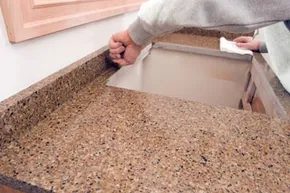
Plastic laminate ruled the roost for decades. If you were lucky, you got wood edging to match your cabinets. That was the peak of “fancy” for a long time. Then came solid-surface acrylics in the ’70s. Corian and Avonite promised heat and stain resistance. They cost more. Only those with deeper pockets cared.
Then granite arrived in the ’80s.
It is one of the hardest natural stones on Earth. It beats Corian in durability. It handles heat and scratches like a champ. Sure, it was expensive. Roughly $70 per square foot back then. Compare that to $40 for Corian and $20 for laminate. People didn’t care. They fell in love. Within a decade, granite became the standard.
The Evolution of Granite Pricing and Aesthetics
By the 2000s, granite changed. It isn’t just black or white speckle anymore. You get many colors. Many patterns. Because it is natural stone, no two slabs look identical. That uniqueness is a selling point for many. Installation is cleaner, too. Fewer seams. Sometimes none at all.
The price dropped significantly, too. It is now much more affordable.
- Entry-level prices: Start around $20 to $35 per square foot.
- High-end prices: Can hit $80 to $100 per square foot depending on the stone and fabrication complexity.
There is a catch. Granite is porous. You must seal it annually. Use a targeted granite stone-sealer. If you skip this, stains seep in. It is a maintenance chore. Some homeowners hate it. Others don’t mind the ritual.
The Radon Controversy and Health Concerns
Granite remains the overwhelming choice for kitchens and bathrooms. A 2012 National Kitchen & Bath Association survey confirmed this. Yet, signs point to a peak in popularity. Why?
Health concerns play a role. Reports suggest granite emits radon gas. Radon is the second-leading cause of lung cancer in America. Granite contains uranium. It also has thorium and potassium. These decay over time. They release radon gas.
Manufacturers argue the levels are puny. They say there is no health risk. Experts agree radiation is low. Most say it isn’t harmful. Some experts note that even low levels present a risk. It is a debate. But it spares some buyers.
Is that the main reason for the dip in popularity? Probably not.
Quartz: The Engineered Contender
The market is eyeing the next best thing. Engineered quartz.
Quartz is made by setting ground quartz into resin. Then it is polished to a sheen. Brands like Silestone, CaesarStone, Cambria, and Zodiaq dominate this space. It costs a bit more than granite. Start around $45 per square foot. People are buying it anyway.
Why? It is more stain-resistant. More durable. It comes in a wider variety of colors. It looks uniform. Natural stone has variation. Quartz does not.
Consumer Reports rated quartz the top performer in 2010. It beat granite in stain, heat, and scratch resistance. Best of all? It needs no annual sealing.
Why Quartz Is Gaining Market Share
Quartz is number two in sales. But it is growing fast. A 2011 Freedonia Group Report showed quartz as the fastest-growing segment.
- Quartz growth: 13 percent.
- Granite growth: 5 percent.
Quartz has all the advantages of granite. Then some. It is twice as strong as granite. It is not porous.
This lack of porosity matters. You don’t need to seal it. It also means the surface won’t promote mold, mildew, or bacteria. That is a huge benefit for hygiene-focused homes.
Other materials like marble and glass are gaining traction. Their market share is small though. If granite is toppled, quartz is the likely successor.
DIY and Installation Realities
If you are planning a renovation, the choice impacts your labor. Granite requires professional fabrication usually. The stone is heavy. Cutting it to fit your cabinetry requires diamond-tipped blades and experience. One wrong cut and you have a ruined slab. Sealing is also a specific chemical process. You need the right product. Doing it wrong leaves streaks or ineffective coverage.
Quartz is engineered. It is still heavy. It still requires professional installation for most people. The resin content makes it slightly more forgiving than natural stone during cutting, but it is not a DIY-friendly material for the average homeowner with a circular saw. You will need templates made by professionals. You will need expert sealing of the edges.
The tools for a DIYer? Maybe a laminate overlay kit if you are staying with budget options. But for stone? You are looking at hiring pros.
The Bottom Line on Countertop Durability
Granite is still king. But its reign is shaky. The maintenance requirement of annual sealing is a friction point. The health debates, even if unfounded for most, create doubt.
Quartz offers a solution. No sealing. High durability. Uniform aesthetics. It costs more upfront. But it saves time later.
Marble is beautiful. But it etches easily. Glass is fragile. It chips. Quartz sits in the middle. Durable. Low maintenance.
The trend is shifting. If you want a countertop that lasts without constant vigilance, quartz is the logical step. If you want the raw, unique beauty of nature and don’t mind the upkeep, granite still holds its ground.
The market is voting with its wallet. Quartz is growing. Granite is stabilizing. The question is not which is better. It is which fits your lifestyle. Do you want to seal your counters every year? Or do you want to forget about them entirely?
There is no wrong answer. Just different commitments.